# Market
A Market is a specific tradable option within an Event. Each market tracks a particular outcome and has its own price, volume, and trading activity.
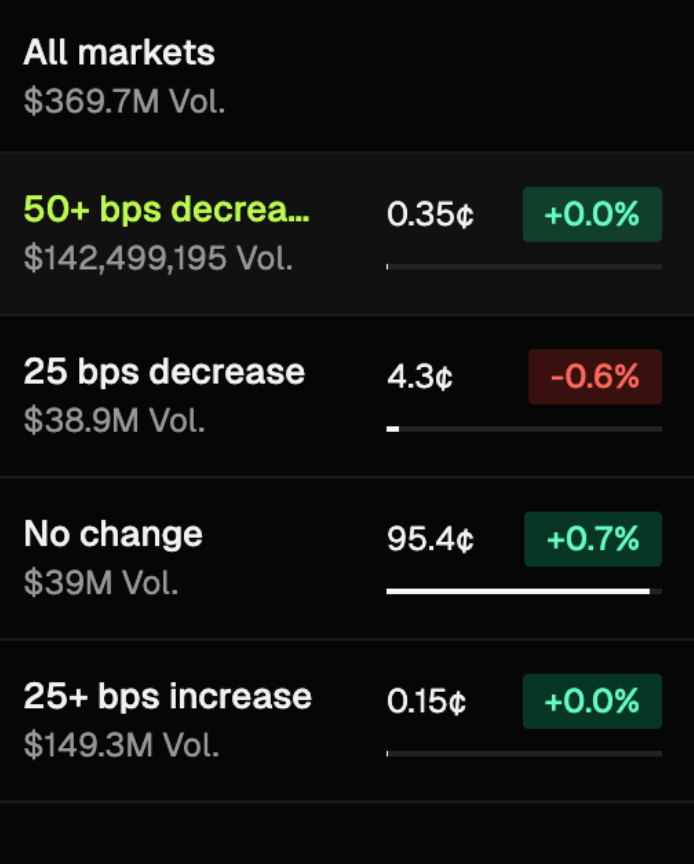
***Example:** Inside the Fed event, there are **4 distinct Markets** you can trade: "50+ bps decrease," "25 bps decrease," "No change," and "25+ bps increase".*
*Each of these is a separate contract where you can buy or sell shares.*
Markets typically follow one of these common patterns:
* **Binary:** The most straightforward type, offering a simple **Yes** **or No** choice on a specific outcome.
* **Threshold:** A directional trade where you predict if a value will be **Above or Below** a specific target (e.g., "Will the project's FDV be above $1B?").
* **Multi-outcome:** A market featuring multiple separate results, allowing you to choose from several different possibilities.
* **Range:** A quantitative structure where outcomes are grouped into specific numeric "buckets" or intervals (e.g., "Price between $10–$20").
***
### FAQs
How is a Market different from an Event?
An Event defines the overall question, while a Market defines the exact outcome you can trade on within that Event.
Can an Event have multiple Markets?
Yes. One Event can contain multiple Markets, each representing a different possible outcome.
What types of Markets are supported?
Markets can be Binary (Yes/No), Threshold, Multi-outcome, or Range-based depending on the structure of the Event.
Why does each Market have its own price and liquidity?
Because each Market is traded independently, with its own supply, demand, and probability based on trader activity.
---
# Agent Instructions: Querying This Documentation
If you need additional information that is not directly available in this page, you can query the documentation dynamically by asking a question.
Perform an HTTP GET request on the current page URL with the `ask` query parameter:
```
GET https://docs.whales.market/whales-prediction/glossary/market.md?ask=
```
The question should be specific, self-contained, and written in natural language.
The response will contain a direct answer to the question and relevant excerpts and sources from the documentation.
Use this mechanism when the answer is not explicitly present in the current page, you need clarification or additional context, or you want to retrieve related documentation sections.